

A Complete Guide to Worm Gearboxes: Types, Selection, Lubrication and Installation
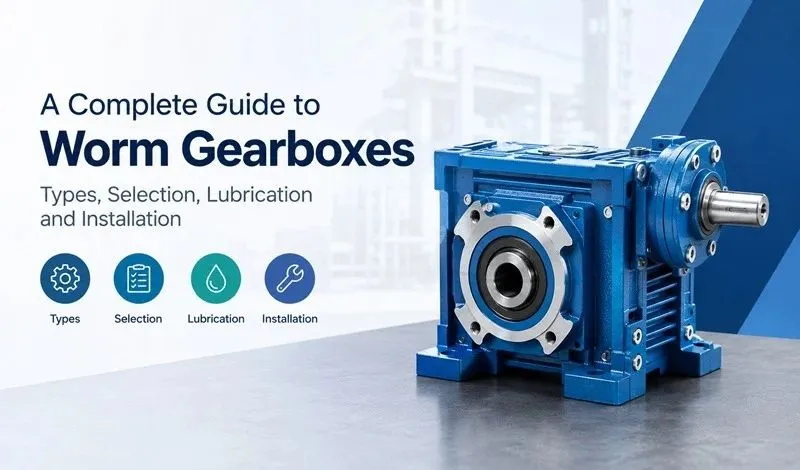
Worm gearboxes are widely used in industrial power transmission because they can provide high reduction ratios in a compact right angle design. They are commonly used in industries such as material handling, packaging, food processing, textiles, and many other industrial applications.
The key things you need to know about worm gearboxes, including their different types and configurations, how to select the right gearbox based on six important parameters, and how to handle proper lubrication, installation, and maintenance.
If you want to understand how the worm and worm wheel mechanism works, you can also refer to our separate guide on worm gears.
Premium Transmission is an established gearbox manufacturer in Pune, India, offering worm gearboxes for a wide range of industrial applications.
Types of Worm Gearboxes by Configuration
Worm gearboxes are available in different configurations to match the layout and space requirements of various machines. Knowing the available options can help you choose a gearbox that fits your application correctly.
Foot Mounted Worm Gearbox (Standard Configuration)
The foot mounted worm gearbox is one of the most commonly used configurations. It has four mounting feet or a base flange at the bottom of the housing, which allows the gearbox to be securely fixed to a base plate, machine frame, or floor.
The position of the input and output shafts can vary depending on the selected mounting position. Foot mounted gearboxes are suitable for most general purpose applications where the unit is installed on a fixed and supported base.
Flange Mounted Worm Gearbox
A flange mounted worm gearbox comes with a machined mounting flange, usually located on the output side. The flange allows the gearbox to be bolted directly to the driven machine or the face of a machine frame.
This setup removes the need for a separate base plate and can help reduce the space needed for installation. It is commonly used when the gearbox needs to be integrated directly into a machine structure.
Shaft Mounted Worm Gearbox (Hollow Bore Output)
A shaft mounted worm gearbox features a hollow bore output that fits directly onto the driven shaft. This design removes the need for a separate output shaft coupling.
A torque arm, also called a reaction arm, is used to prevent the gearbox housing from rotating during operation. This configuration is useful for conveyor tail shafts, rotary table drives, and applications where shaft alignment is difficult or available space is limited.
Vertical Shaft Worm Gearbox
Some worm gearbox designs are available with a vertical input shaft positioned above or below the worm wheel. This configuration is often used when the motor needs to be installed vertically above the gearbox.
For example, vertical shaft gearboxes can be used in agitator drives where the impeller shaft extends vertically into a tank. These models require the correct oil level and filling arrangement based on the shaft orientation.
Extended Output or Double Ended Output
Some machines need power to be transferred from both sides of the output shaft. A double ended output worm gearbox has an output shaft that extends through both sides of the gearbox housing.
This configuration can be useful in twin drive conveyor systems and other applications where both ends of the output shaft need to be connected.
| Mounting Type | Applications | Key Advantages |
|---|---|---|
| Foot-mounted | Conveyors, mixers, general drives | Universal, suits most mounting arrangements |
| Flange-mounted | Machine-integrated drives, vertical drives | No separate base plate, smaller footprint |
| Hollow bore / shaft-mounted | Conveyor tail shafts, rotary tables | No output coupling required, saves alignment time |
| Vertical input shaft | Tank agitators, vats, vertical pumps | Clean integration for vertical process drives |
| Double-ended output | Twin conveyor drives, dual-feed systems | Simultaneous drive from both output shaft ends |
Six Parameters to Define When Selecting a Worm Gearbox
Choosing the right worm gearbox requires you to define six important parameters. Having these details ready before speaking with a manufacturer or checking a product catalogue can make the selection process easier and more accurate.
- Output Torque (Nm)
First, determine the output torque required for your application. You can calculate the required torque using the motor power, gear ratio, and gearbox efficiency. The calculated value should then be multiplied by the suitable service factor based on the application. Output torque is one of the most important factors when selecting a gearbox.
- Gear Ratio
The gear ratio is calculated by dividing the Input speed to the gearbox in RPM by the required output speed in RPM. Once you know the required ratio, choose the closest standard gear ratio available in the manufacturer’s product catalogue.
- Input Power and Motor Speed
The motor power and input speed are needed to check whether the gearbox can handle the required thermal load during operation. The gearbox should be selected based on both its mechanical torque capacity and its thermal power rating.
- Duty Cycle and Service Factor
Consider how the gearbox will operate in your application. Determine whether the drive will run continuously or intermittently and whether it will experience shock loads or frequent starting and stopping.
These operating conditions help determine the appropriate service factor that should be used when calculating the required torque.
- Mounting Configuration and Output Type
Identify how the gearbox will be installed and connected to the driven machine. Common options include foot mounted, flange mounted, and shaft mounted configurations.
You should also specify whether you need a solid output shaft, a single ended or double ended shaft, or a hollow bore output. The output shaft size and keyway dimensions should also match the requirements of the driven machine.
- Operating Environment
Consider the conditions in which the gearbox will operate. Check whether it will be installed indoors or outdoors and identify the expected ambient temperature range.
You should also consider exposure to dust, water, high humidity, or chemicals. These conditions can affect the required IP rating and housing material of the gearbox.
Worm Gearbox Efficiency: What the Numbers Mean for Your Energy Bill
Worm gearbox efficiency varies significantly with gear ratio, more than any other gearbox type. This is because worm gear contact is predominantly sliding (not rolling), and friction increases as the helix angle decreases with higher ratios.
| Reduction Ratio | Approximate Efficiency | Notes |
|---|---|---|
| 5:1 to 10:1 | 80–90% | Multi-start worm; good efficiency |
| 10:1 to 20:1 | 75–85% | Moderate efficiency, check thermal rating on continuous duty |
| 20:1 to 40:1 | 65–78% | Increasing friction, thermal rating often binding constraint |
| 40:1 to 60:1 | 58–70% | Higher heat generation, forced cooling may be needed |
| 60:1 to 100:1 | 52–65% | High friction, oil cooling and thermal management important |
For a 7.5 kW motor driving through a 40:1 worm gearbox at 70% efficiency, the heat generated in the gearbox is: 7,500 × (1 − 0.70) = 2,250 W, continuous. That is enough heat to raise housing temperature significantly in a warm ambient. Always check the manufacturer’s thermal power rating for continuous operation, and specify cooling if needed.
Worm Gearbox Lubrication: Getting It Right
Lubrication is the single most important maintenance factor for worm gearbox service life. The worm-to-worm-wheel sliding contact requires a specific type of oil with extreme pressure (EP) additives, standard gear oil is insufficient.
Oil Type and Viscosity Selection
| Ambient Temperature | Recommended Oil Viscosity Grade | Notes |
|---|---|---|
| -10°C to 10°C | ISO VG 100 or VG 150 | Low-viscosity for cold startprevents oil starvation |
| 10°C to 35°C | ISO VG 220 | Most common Indian industrial conditions |
| 35°C to 55°C | ISO VG 320 | High ambient, increased viscosity maintains oil film |
| 55°C to 70°C (hot environment) | ISO VG 460 | Very high ambient, consult manufacturer for cooling options |
Oil type: Use a mineral or synthetic gear oil with EP (Extreme Pressure) additives specifically rated for worm gears. Do not use standard gear oil without EP additives, the high contact pressure at the worm-wheel interface requires EP protection. Synthetic gear oils (PAO or polyglycol-based) can significantly improve efficiency and extend oil change intervals in high-performance applications.
Oil Change Intervals
| Condition | Initial Oil Change | Subsequent Oil Changes |
|---|---|---|
| New gearbox (mineral oil) | After first 500 hours of operation | Every 2,000–3,000 hours or 12 months (whichever first) |
| New gearbox (synthetic oil) | After first 500 hours of operation | Every 5,000–8,000 hours or 24 months |
| High-temperature continuous duty | After first 500 hours | Every 1,000–2,000 hours, check discolouration |
| Outdoor or humid environment | After first 500 hours | Every 1,000–2,000 hours, inspect for water ingress |
Worm Gearbox Installation: What to Do and What to Avoid
Proper installation is important for reliable worm gearbox performance and service life. Incorrect installation can lead to premature wear and gearbox failure. Follow these points carefully when installing and commissioning a worm gearbox.
Oil Level and Filling
Worm gearboxes may be supplied without oil or with oil added for testing. Check the delivery note to confirm the condition of the gearbox when it is delivered.
Before operation, fill the gearbox with the correct amount of oil based on its mounting orientation. The correct oil level plug position is normally shown on the housing drawing for each mounting position. Always follow the manufacturer’s installation drawing when filling the gearbox.
Too much oil can increase churning losses and may cause the seals to leak or fail. Too little oil can reduce lubrication on the gear surfaces and lead to faster wear.
Shaft Alignment
Make sure the motor and gearbox coupling are properly aligned and remain within the manufacturer’s specified tolerance. As a typical reference, parallel offset should be below 0.05 mm and angular misalignment should be below 0.5 degrees, unless the manufacturer specifies different limits.
Poor alignment can place uneven loads on the input shaft bearings and may reduce their service life.
Mounting Bolts
Tighten all gearbox mounting bolts to the torque value specified by the manufacturer. Properly tightened bolts help keep the gearbox stable during operation.
Loose mounting bolts can create vibration, which may affect oil seals, cause fatigue in housing flanges, and loosen the connected couplings.
Breather Location
Check that the breather valve is installed in the correct position for the selected mounting orientation. The breather should be positioned at the highest point of the gearbox housing so that oil does not reach it during normal operation.
A blocked or incorrectly positioned breather can increase internal pressure and may cause the oil seals to leak or fail.
Motor Coupling Selection
Use a flexible coupling to connect the motor to the gearbox input shaft. A rigid coupling should be avoided because it does not allow for minor alignment variations.
A flexible coupling can accommodate small amounts of misalignment and help reduce the transmission of starting shocks from the motor to the gearbox gears.
PT’s Worm Gearbox Range
As established gearbox manufacturers in Pune, India, Premium Transmission manufactures a complete range of worm gearboxes for industrial applications:
- Standard Worm Gearbox: General industrial drives, conveyors, packaging, food processing, textile. Ratios 5:1 to 100:1. Cast iron housing, centrifugally cast phosphor bronze worm wheel, precision-ground and case-hardened alloy steel worm shaft.
- High Torque Worm Gearbox: Heavy-duty applications, mining, sugar mills, heavy agitators, winches, construction drives. Reinforced housing, oversized taper roller bearings, heavy-section centrifugally cast bronze worm wheel.
Both product lines are ISO 9001 certified. Genuine spare parts, Phosphor bronze worm wheels, input and output bearings, oil seals, are available from our Pune manufacturing facility. Contact our engineering team to discuss your application or request a quotation. Find Us in Pune
Worm Gearbox Maintenance Checklist
Use this checklist for ongoing maintenance of worm gearboxes in your plant:
| Task | Frequency | Acceptance Criteria |
|---|---|---|
| Oil level check | Every month | Oil at correct level for mounting orientation, top up with same oil grade if low |
| Oil condition inspection | Every 3 months | Clear amber colour, no milky appearance (water), no metal particles visible |
| Housing temperature check | Every week (continuous duty) | Below 80°C operating temperature, investigate if rising trend observed |
| Noise and vibration check | Every shift (operator) | No unusual whining, grinding, or increased vibration compared to baseline |
| Seal inspection (visual) | Every 3 months | No oil weeping at input or output shaft seals, replace if leaking |
| Breather valve inspection | Every 6 months | Valve free of blockage, correct position for mounting orientation |
| Coupling condition check | Every 6 months | No cracking or deformation of flexible coupling element, replace if worn |
| Fastener torque check | Annually | All mounting and coupling bolts at specified torque, re-torque if required |
| Full oil change (mineral oil) | Every 2,000–3,000 hours or 12 months | Drain completely, flush if contaminated, refill with fresh EP gear oil |
| Bronze worm wheel inspection | Annually (if accessible) or at first oil change | Inspect for pitting, spalling, or abnormal wear, stock replacement if significant wear |
Frequently Asked Questions
What is a worm gearbox?
A worm gearbox is a complete power transmission unit consisting of a worm and a worm wheel (toothed bronze gear) enclosed in a cast housing with bearings, seals, lubrication, and mounting provisions. It reduces input speed and multiplies output torque between two perpendicular, non-intersecting shafts, delivering reduction ratios from 5:1 to 100:1 in a compact right-angle unit.
What are the different types of worm gearboxes?
Worm gearboxes are classified by reduction stages (single reduction 5:1 to 100:1, or double reduction 100:1 to 3,600:1) and by mounting configuration (foot-mounted, flange-mounted, hollow-bore shaft-mounted, vertical shaft, or double-ended output). Within these types, worm gearboxes are further classified by torque rating, standard duty or high torque heavy-duty variants.
What oil should I use in a worm gearbox?
Use a mineral or synthetic gear oil with EP (Extreme Pressure) additives, at the correct ISO viscosity grade for your operating temperature. For typical Indian industrial conditions (10°C to 35°C ambient), ISO VG 220 EP gear oil is the standard specification. For high-ambient environments above 35°C, use ISO VG 320. Always check the gearbox manufacturer’s lubrication specification, the correct oil type is critical for worm gearbox service life.
How do you install a worm gearbox correctly?
Fill to the correct oil level for your mounting orientation before commissioning. Align the input coupling to within 0.05 mm parallel offset and 0.5 degrees angular misalignment. Torque all mounting bolts to specification. Confirm the breather valve is at the highest point of the housing for your mounting orientation. Use a flexible (not rigid) coupling between motor and gearbox input shaft. After commissioning, change the oil after the first 500 hours of operation to flush break-in wear particles.
How long do worm gearboxes last?
A correctly specified, correctly installed, and correctly maintained worm gearbox can last 15,000–30,000+ service hours. The bronze worm wheel will wear progressively over service life, it is the designed sacrificial component. The worm shaft typically outlasts multiple worm wheel replacements when the gearbox is correctly lubricated and not overloaded. Bronze worm wheel replacement is the main planned maintenance event for worm gearboxes in long-running applications.
What is the difference between single and double reduction worm gearbox?
A single reduction worm gearbox has one worm and one worm wheel, delivering ratios from 5:1 to 100:1. A double reduction worm gearbox has two worm gear stages in series, where the output of stage one drives stage two, delivering ratios from 100:1 to approximately 3,600:1. Double reduction units are used for extremely low output speeds such as slow agitators and valve actuators. They are larger, less efficient, and more expensive than single reduction units.