

A Complete Guide to Helical Gearboxes: Types, Working Principle and Applications
A Complete Guide to Helical Gearboxes: Types, Working Principle and Applications
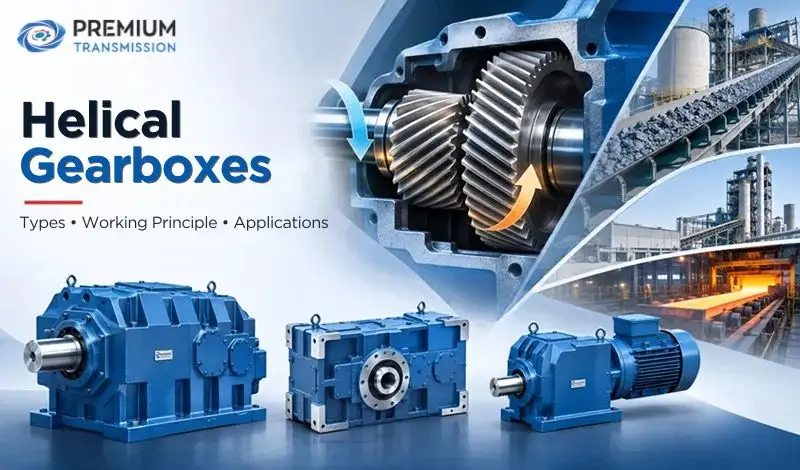
Helical gearboxes are used in many industrial machines to control speed and transfer power from a motor to the equipment being driven. They use gears with angled teeth, known as helical gears. The angled tooth design allows the gears to engage progressively, which supports smooth power transmission and can help keep operating noise low. Premium Transmission manufactures helical gearboxes and helical geared motors in Pune, Falta & Shendra for industrial applications in India and international markets.
Choosing a gearbox is not only about reducing speed. The gearbox must also match the torque, load, operating conditions, and requirements of the machine. This guide explains the basic working of a helical gearbox, the different types available, their common uses, and the important points to consider before selecting one.
What Is a Helical Gearbox?
A helical gearbox is a gear-based speed reduction unit placed between a motor and a driven machine. Its main job is to lower the input speed and provide higher torque at the output. Depending on the required reduction, a gearbox may use a single gear pair or several gear stages.
Each stage normally has two gears. The smaller gear, called the pinion, drives the larger gear or gear wheel. The difference in the number of teeth between these gears determines how much the speed is reduced. As the speed decreases through the gearbox, the available output torque increases, subject to the gearbox’s efficiency and operating conditions.
Helical gears are different from spur gears because their teeth are not straight across the gear. They are cut at an angle, known as the helix angle. Common helical gear designs use angles in the range of about 08 to 30 degrees.
When the gears rotate, the angled teeth enter into contact progressively instead of engaging across the entire tooth at the same instant. This creates a smoother transfer of load between the mating teeth. As a result, helical gear systems can provide smoother and quieter operation and can handle substantial loads within an appropriately designed gearbox.
The actual performance depends on factors such as gear size, material, lubrication, load, speed, gearbox design, and operating conditions.
How Does a Helical Gearbox Work?
Power enters the gearbox at the input shaft, which is connected to the input pinion. The pinion meshes with a larger gear wheel, reducing speed and increasing torque in proportion to the gear ratio. In a multi-stage gearbox, the output of the first stage becomes the input of the second stage, and so on, until the final output shaft delivers the required speed and torque.
Helical Gear Tooth Engagement
Because the teeth are helical, engagement starts at the leading edge of the tooth and sweeps progressively across the tooth face as the gears rotate. This gradual engagement distributes the transmitted load across a larger contact area at any given instant. The effect is lower peak contact stress, reduced vibration, lower noise level, and higher power density per unit of gear size compared to spur gears.
The helix angle also creates an axial thrust force along the shaft during operation. Helical gearbox bearings are selected to handle this axial load in addition to the radial gear forces. Premium Transmission engineers size bearings to the full force envelope of each gear stage, ensuring rated bearing life is achieved under actual operating conditions.
Efficiency
Each helical gear stage operates at 98 to 99 percent efficiency under full load. A two-stage helical gearbox therefore achieves 96 to 98 percent overall efficiency, and a three-stage unit achieves 94 to 97 percent. This makes helical gearboxes the most efficient standard gearbox type, significantly more efficient than worm gearboxes (70 to 90 percent) and comparable with planetary gearboxes in straight parallel-shaft configurations.
Types of Helical Gearbox Manufactured by Premium Transmission
Premium Transmission manufactures helical gearboxes across three main product lines, covering light industrial drives through to the most demanding continuous-duty applications in cement, mining, and steel industries.
Standard Helical Gearbox
The standard helical gearbox is Premium Transmission’s general-purpose speed reducer for industrial applications. It is available in a wide range of frame sizes and gear ratios, covering input powers from fractional kW up to several hundred kW. Standard helical gearboxes are used wherever a reliable, compact, and efficient parallel-shaft drive is needed.
Shaft arrangement: parallel input and output shafts (in-line or offset).
Gear ratio range: 1.22:1 up to 657:1 in multi-stage configurations.
Mounting options: foot mounting, flange mounting, shaft mounting.
Output shaft: solid or hollow bore for direct shaft mounting.
Typical applications: conveyors, mixers, pumps, fans, packaging machines, agitators, general machinery.
See our Standard Helical Gearbox range for frame sizes, power ratings and dimensional data.
Modular Helical Gearbox
The modular helical gearbox is built on a modular platform where gear stages, housings and output configurations can be combined to match a wide range of application requirements from a standardised set of components. Modular design means shorter delivery times, easier spare parts management and interchangeability across a range of ratios and output configurations.
Key advantage: one base platform covers a very wide ratio range, motor flanges, output shaft types and mounting arrangements can be mixed and matched.
Suitable for: OEM machine builders, conveyor system integrators and process plant operators needing multiple gearbox configurations with common spare parts.
Available with: IEC motor flanges for direct motor mounting as a modular helical geared motor.
Heavy Duty Helical Gearbox
The heavy duty helical gearbox is designed for continuous operation under high torque, shock loading and arduous environmental conditions. Heavy duty units use larger gear face widths, higher-strength alloy steel gears with precision grinding, reinforced cast iron or fabricated steel housings, and heavy-duty bearings with extended L10 life ratings.
Service factor: designed for SF 1.5 to 2.5 depending on load type, suitable for crusher drives, mill drives, kiln drives and other shock-load applications.
Thermal rating: sized for continuous duty in high-ambient-temperature locations such as cement plants and steel mills.
Special variants: Premium Transmission produces special helical gearboxes for crane duty, cooling tower drives, extruder drives, pinion stand applications in rolling mills, and coiler/uncoiler drives.
Typical industries: cement, mining, steel, sugar, ports, paper and power.
Helical Geared Motor
A helical geared motor combines a helical gearbox with a flange-mounted electric motor in a single compact unit. The motor is directly mounted to the gearbox input flange, no separate coupling, no alignment work. Helical geared motors from Premium Transmission are available in foot-mounted, flange-mounted, and shaft-mounted configurations with IEC standard motor flanges.
Geared motors simplify installation, reduce the number of components, and minimise the drive train footprint. They are widely used in conveyors, agitators, packaging machinery, material handling and general industrial automation.
Helical Gearbox vs Other Gearbox Types
| Feature | Helical Gearbox | Worm Gearbox | Planetary Gearbox | Bevel Helical Gearbox |
| Shaft arrangement | Parallel | Right angle (90°) | Coaxial (in-line) | Right angle (90°) |
| Efficiency per stage | 98 to 99% | 70 to 90% | 97 to 99% | 95 to 97% |
| Noise level | Low | Very low | Low to medium | Low |
| Gear ratio range | 1.22:1 up to 657:1 | 5:1 to 100:1 | 3:1 to 10,000:1 | 5:1 to 438:1 |
| Load capacity | High | Medium | Very high | High |
| Compactness | Compact | Moderate | Very compact | Compact |
| Best for | General Industrial Drives | Low-speed, low-power, quiet drives | High-ratio, high-torque compact drives | Right-angle heavy duty drives |
Helical Gear Applications: Industries and Use Cases
Helical gears are used across virtually every sector of manufacturing and process industry. The table below shows where Premium Transmission’s helical gearboxes are deployed:
| Industry | Typical Application | Gearbox Type |
| Cement | Raw mill drives, cement mill drives, kiln drives, conveyors | Heavy Duty Helical |
| Mining and Quarrying | Belt conveyor drives, crusher pre-drives, bucket elevator drives, Stacker -reclaimer | Heavy Duty Helical |
| Steel and Metal | Rolling mill table drives, coiler drives, pinion stands, Levellers, pinch roll | Special Heavy Duty Helical |
| Sugar | Cane table drives, juice conveyor drives, centrifuge drives, Bagasse drives | Standard or Heavy Duty Helical |
| Power Plants | Coal handling conveyors, ash handling drives, cooling tower Coal mills | Standard or Heavy Duty Helical |
| Ports and Bulk Handling | Ship loader drives, stacker-reclaimer drives, conveyor drives | Heavy Duty Helical |
| Rubber and Plastics | Extruder gearboxes, mixing mill drives, calendering drives | Special Helical (Extruder Duty) |
| Paper and Pulp | Refiner drives, winder drives, stock pump drives, Pulper | Standard or Heavy Duty Helical |
| Food and Beverage | Mixer drives, conveyor drives, blender drives | Standard Helical Geared Motor |
| General Manufacturing | Conveyor drives, agitator drives, fan drives, pump drives | Standard Helical or Geared Motor |
How to Select a Helical Gearbox
Choosing the right helical gearbox for your application involves the following steps. Premium Transmission’s engineering team handles this process in full, but understanding the parameters helps you provide the right information:
Step 1: Calculate Required Output Torque and Speed
- Output speed (RPM): the required speed of the driven shaft, not the motor speed.
- Output torque (Nm): calculated from the power required by the load at the output shaft speed. Torque = (Power in kW × 9550) / Output RPM.
- Gear ratio: Input rpm to Gearbox divided by required output RPM. Example: 1450 RPM input, 50 RPM output = ratio 29:1.
Step 2: Apply the Service Factor
The service factor accounts for load characteristics beyond steady-state running. It is multiplied by the motor rated power to give the gearbox selection power:
- Uniform load (fans, centrifugal pumps, light conveyors): service factor 1.0 to 1.25.
- Moderate shock loads: For applications such as heavy conveyors, mixers, and loaded conveyors, a service factor of 1.25 to 1.75 is commonly considered.
- Heavy shock loads: Crushers, mills, hammer applications, and reversing drives can experience much higher load variations. These applications may require a service factor of 1.75 to 2.5.
Step 3: Check the Mounting and Shaft Details
The gearbox must physically fit the machine and connect correctly to the motor and driven equipment. Before finalising the gearbox, check the following:
- Mounting arrangement: Depending on the installation, you may need a foot-mounted B3, flange-mounted B5, or shaft-mounted gearbox.
- Output shaft: Decide whether a solid shaft or hollow bore is required. The shaft diameter and keyway should also be compatible with the driven machine.
- Motor connection: For a geared motor, check the required IEC motor frame size and the matching motor flange.
Step 4: Look at the Working Environment
The conditions around the gearbox can affect its selection, sealing, cooling, and maintenance requirements.
- The expected ambient temperature and whether additional or forced cooling may be needed in high-temperature areas.
- Exposure to dust, moisture, or chemicals, along with the required IP rating and seal arrangement.
- The number of operating hours per day and how easily regular maintenance can be carried out.
Need Help Selecting the Right Gearbox?
The correct gearbox depends on the motor, load, operating conditions, and available installation space. You can share your motor datasheet, load details, and installation layout with Premium Transmission. Our team can review the application and provide a suitable selection along with the relevant technical data sheet.
Why Choose Premium Transmission as Your Helical Gearbox Manufacturer?
Premium Transmission is an ISO 9001-certified helical gearbox manufacturer and one of the leading gearbox manufacturers in India, headquartered in Pune with four manufacturing plants. Our helical gearbox range has been developed over four decades of application engineering across India’s most demanding industries.
- In-house gear manufacturing: gears are cut from alloy steel billets, hardened, and precision-ground at our Pune, Falta & Shendra facilities. No outsourced gear cutting, full quality control from raw material to finished gear.
- ISO 9001 certified quality: every gearbox undergoes dimensional inspection, no-load running test and oil leak check before despatch.
- Application-specific design: our engineers design special helical gearboxes for crane duty, cooling towers, extruders, rolling mills and other non-standard applications, not just catalogue selection.
- Complete drive packages: we supply the gearbox, geared motor, fluid coupling and associated drive components as a matched, engineered package.
- Pan-India network: sales offices and service support across India, with a track record in cement, mining, steel, sugar, power and material handling.
- Proven export record: Premium Transmission gearboxes are installed in industrial plants internationally, backed by our Pune, Falta & Shendra manufacturing base.
Visit our manufacturing facility or contact our engineering team for a helical gearbox quotation or technical consultation.
Frequently Asked Questions About Helical Gearboxes
What is a helical gearbox?
A helical gearbox is a speed-reducing gearbox that uses helical gears, gears with teeth cut at a helix angle to the gear axis, to transmit torque between parallel shafts. The angled teeth produce gradual, smooth engagement that results in low noise, high load capacity and efficiency of 98 to 99 percent per gear stage. Helical gearboxes are the most widely used industrial speed reducer for conveyor drives, mixer drives, pump drives and general industrial machinery.
What are the types of helical gearbox?
The main types of helical gearboxes are: Standard Helical Gearbox (general-purpose, parallel shaft, wide ratio range); Modular Helical Gearbox (modular platform for flexible configurations and common spare parts); Heavy Duty Helical Gearbox (for high-torque, shock-load and continuous-duty applications in cement, mining and steel); and Helical Geared Motor (motor and gearbox combined in one unit). Special-purpose variants include crane duty, extruder, cooling tower, pinion stand and coiler gearboxes. Premium Transmission manufactures all these types at its Pune, Falta & Shendra facilities.
What are helical gears used for?
Helical gears are used in industrial gearboxes wherever smooth, efficient, high-capacity torque transmission is needed between parallel shafts. Common applications include conveyor drives, mixer and agitator drives, pump and fan drives, extruder gearboxes, rolling mill drives and general machinery speed reduction. Their low noise, high efficiency and ability to transmit high torque in a compact size make them the standard choice for most industrial drives.
What is the efficiency of a helical gearbox?
A helical gearbox achieves 98 to 99 percent efficiency per gear stage. A two-stage helical gearbox operates at approximately 96 to 98 percent overall efficiency, and a three-stage unit at approximately 94 to 97 percent. This makes helical gearboxes significantly more efficient than worm gearboxes (70 to 90 percent) and suitable for energy-sensitive applications where running costs over the gearbox lifetime are important.
How many types of gearboxes are there?
The four main types of industrial gearboxes are: Helical gearbox (parallel shaft, high efficiency, most common); Worm gearbox (right angle, high ratio in one stage, lower efficiency); Planetary gearbox (coaxial, very compact, high torque density); and Bevel helical gearbox (right angle, high efficiency, for heavy-duty drives). Premium Transmission manufactures all four types plus fluid couplings and geared motors at its Pune, Falta & Shendra manufacturing plants.
Why is a gearbox used with a motor?
A gearbox is used with a motor to convert the motor’s high-speed, low-torque output into the lower speed and higher torque that most industrial machines require. Electric motors run efficiently at speeds of 750 to 3,000 RPM, but conveyors, mixers, pumps and other industrial machines typically need 5 to 500 RPM with correspondingly high torque. A helical gearbox bridges this gap, reducing speed and multiplying torque in proportion to the gear ratio, while maintaining the motor at its efficient operating speed.
What makes Premium Transmission a reliable helical gearbox manufacturer?
Premium Transmission is ISO 9001-certified, manufactures gears entirely in-house at its four plants, and has over four decades of application engineering experience in helical gearboxes for cement, mining, steel, sugar, power and material handling industries. All gearboxes are inspected, dimensionally verified, and tested before despatch. Our engineering team provides full application support from initial selection through to installation and commissioning. Contact us to discuss your requirements.