

Planetary Gearbox vs Helical Gearbox: Which Is Right for Your Application?
Choosing between a planetary gearbox vs helical gearbox is not always straight-forward, especially when the application involves high loads or limited installation space. Both gearbox types are widely used in industrial applications and can deliver reliable, efficient performance when they are correctly selected corectly.
Premium Transmission is the manufacturer for both types of gearboxes in Pune and Falta(WB) in India. Planetary and helical gearboxes are designed differently, so the better choice depends on what the application actually needs. Choosing a gearbox simply because it is compact, powerful, or efficient can result in higher costs or performance issues later.
We are comparing planetary and helical gearboxes based on important factors such as load capacity, efficiency, size, noise, application requirements, and operating conditions. A simple comparison table at the end will also help you understand which gearbox may be more suitable for different industrial applications.
How Each Gearbox Type Works: A Quick Recap
Planetary Gearbox
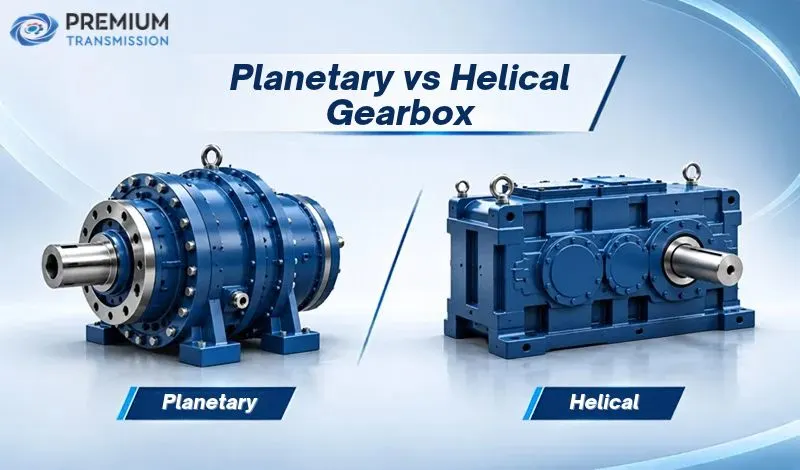
Think of a planetary gearbox as a small gear system where several gears work together. At the centre is the sun gear. Around it, a set of planet gears rotates inside the outer ring gear.
One of the main benefits of this arrangement is the way the load is distributed among the planet gears. This allows a planetary gearbox to transmit high torque while keeping the overall gearbox relatively compact. The input and output are also placed on the same centre line, giving it a coaxial design.
Depending on the design and operating conditions, efficiency per stage is typically around 97% to 99%.
Helical Gearbox
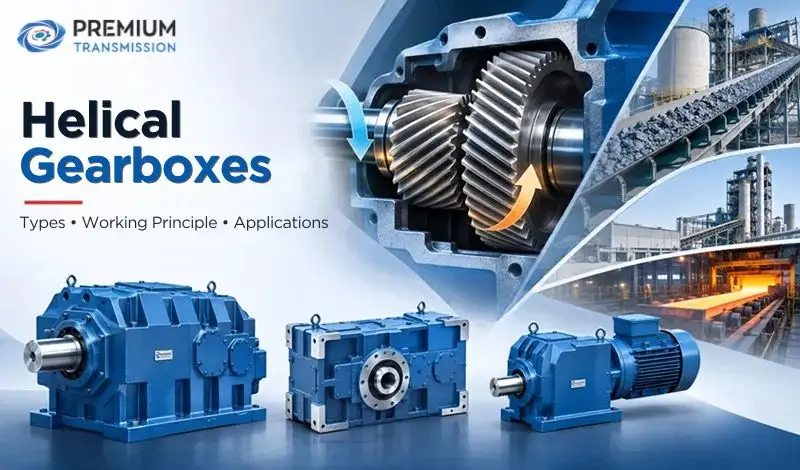
A helical gearbox uses gears with teeth that are cut at an angle rather than straight across the gear. These angled teeth come into contact gradually, with several teeth engaged during power transmission.
This design helps the gearbox transfer power smoothly and can reduce operating noise. It also makes helical gearboxes suitable for many applications where reliable power transmission and high load handling are needed. Efficiency per stage is typically in the range of 96% to 99%. Their combination of efficiency, reliability, and practical cost makes helical gearboxes a common choice for a wide range of industrial equipment.
Planetary Gearbox vs Helical Gearbox: Full Comparison
| Comparison Factor | Planetary Gearbox | Helical Gearbox |
| Shaft arrangement | Co-axial (input and output inline) | Parallel shafts |
| Torque density | Very high load shared across planets | Moderate to high, single gear mesh |
| Efficiency per stage | 97 to 99% | 96 to 99% |
| Typical reduction (single stage) | 3:1 to 10:1 | 1.22 :1 to 5.06:1 |
| Noise level | Low | Low |
| Torsional stiffness | High, suited to precision drives | Moderate |
| Physical size at same torque | Very compact | Larger |
| Unit cost | Higher due to manufacturing complexity | More cost-effective |
| Best duty | Continuous heavy duty, high torque | Continuous general industry duty |
| Typical applications | Sugar mills, steel rolling, stacker-reclaimers, slew drives | Conveyors, mixers, fans, agitators, packaging |
Where Does Each Type Excel in Indian Industry?
Where Planetary Gearboxes Fit Best
Sugar mills are a good example of an application where a planetary gearbox can make sense. Crushing operations require very high torque, and the gearbox may have to work continuously during the sugar season. At the same time, the available installation space inside the mill can be limited.
A planetary gearbox can provide high torque from a relatively compact, coaxial arrangement. This can be useful when a conventional gearbox would require more installation space for a similar rating.
Premium Transmission’s Modular Planetary Gearbox range is available for torque ratings up to 6700 kNm, with nominal ratios from 16 to 1600. This range covers applications that require high torque as well as applications where a wider range of reduction ratios is needed.
Planetary gearboxes can also be used in applications such as steel rolling mills, stacker-reclaimers, crane slew drives, and chemical plant clarifiers. In these cases, the combination of high torque capacity and an inline shaft arrangement can be an important part of the gearbox selection.
Where Helical Gearboxes Fit Best
Helical gearboxes are commonly considered for a wide range of general industrial drives where practical installation and cost are important factors. Conveyor systems, mixers, agitators, fans, material handling equipment, and continuous-process machinery are some examples.
Industries such as cement, rubber, paper, and food processing use these types of drives across different applications. A helical gearbox can be suitable where the required reduction and operating conditions fall within its design range.
Premium Transmission’s Standard Helical Gearbox range supports power ratings up to 5573 kW. Different mounting arrangements and application-specific configurations are available for equipment such as extruders, aerators, cooling towers, and stirrer-agitator drives.
The choice between a planetary and helical gearbox therefore depends on the actual application. Required torque, reduction ratio, available space, power rating, mounting arrangement, and operating conditions should all be considered before selecting the gearbox.
Which Should You Choose? Application Decision Table
| If Your Application Has… | Choose Planetary | Choose Helical |
| High torque in limited space | Yes, high torque density is the defining advantage | Only if space allows a larger unit |
| Input and output shafts must be inline | Yes, coaxial arrangement is standard | No, helical uses parallel shafts |
| Continuous duty at high load | Yes, up to 99% efficiency, low heat | Yes, also high efficiency for continuous duty |
| Standard reduction 5:1 to 25:1 | Can be used but adds unnecessary cost | Yes, this is the ideal range for helical |
| Budget is a primary constraint | Evaluate carefully; planetary costs more | Yes, more cost-effective at standard ratios |
| Precision positioning required | Yes, high torsional stiffness | Less suited for high-precision motion control |
Can You Use a Planetary Gearbox Where a Helical Would Work?
Yes, a planetary gearbox can mechanically replace a helical in many applications. The question is whether the additional cost is justified. If the application does not require high torque density, coaxial alignment, or high torsional stiffness, specifying a planetary adds cost without adding capability. Established helical gearbox manufacturers offer modular designs that cover a wide range of mounting configurations and ratios, making the helical the right default for standard industrial drives.
The reverse is also true in some cases. If a helical gearbox can be made to fit the available space with a different mounting arrangement, it may be the better value choice even where a planetary could work. Application engineers at Premium Transmission review both options when the requirements sit near the boundary between the two types.
How Premium Transmission Supports the Selection Decision
As gearbox manufacturers with both planetary and helical product lines, our team does not start with a preference for one type. We review your application data, including output torque, input speed, reduction ratio, duty cycle, shaft arrangement, and site conditions, and recommend the configuration that best fits your requirements and budget. You can discuss your application with our engineering team via the contact page, or visit our manufacturing facility in Pune to see the product range in person.
Frequently Asked Questions
Q1. What is the main difference between a planetary gearbox and a helical gearbox?
The main difference is in how they transmit power and what that means for size and performance. A planetary gearbox shares load across multiple planet gears and has coaxial (inline) shafts, giving very high torque in a compact body. A helical gearbox transmits power through parallel-shaft helical gears, offering high efficiency and smooth operation at a lower cost for standard reduction requirements. Planetary gearboxes are chosen when torque density and inline shaft layout are critical; helical gearboxes are the standard choice for general industrial drives.
Q2. Which gearbox is more efficient: planetary or helical?
Both achieve similar efficiency levels. A planetary gearbox typically operates at 97 to 99% efficiency per stage, and a helical gearbox at 96 to 99% per stage. In practice, the efficiency difference between the two is small.
Q3. Is a planetary gearbox more expensive than a helical gearbox?
Yes. Planetary gearboxes carry a higher unit cost than helical gearboxes at comparable torque ratings. The additional cost reflects the manufacturing precision required for the planet gears, ring gear, and carrier assembly. For applications where the torque density or coaxial layout justifies it, the total cost of ownership over the equipment life is competitive. For standard drives where neither constraint applies, a helical gearbox is the more cost-effective choice.
Q4. Which gearbox type is better for sugar mills in India?
Planetary gearboxes are the standard choice for sugar mill main drives in India. The torque requirements during cane crushing are very high, the available installation space is often limited by the mill structure, and the duty is continuous for long operating seasons. The planetary gearbox delivers the required torque in a compact, coaxial package that fits within the mill layout. Premium Transmission manufactures sugar mill planetary gearboxes with torque ratings up to 6700 kNm specifically for this application.
Q5. Can gearbox manufacturers supply both planetary and helical gearboxes from a single source?
Yes. Premium Transmission, as an established gearbox manufacturing company based in Pune, India, manufactures both planetary and helical gearboxes along with worm gearboxes, bevel helical geared motors, and fluid couplings. Sourcing both types from a single manufacturer ensures compatible interface dimensions, consistent quality standards, unified spare parts management, and a single technical contact for application support across your full drivetrain.
About Premium Transmission
Premium Transmission is a gearbox manufacturing company headquartered in Pune, India, with four ISO 9001-certified manufacturing plants. Among the established gearbox manufacturers in India, Premium Transmission supplies modular planetary gearboxes, helical gearboxes, worm gearboxes, bevel helical geared motors, and fluid couplings to industries including sugar, steel, cement, mining, and material handling across India and international markets. Explore the Modular Planetary Gearbox and Standard Helical Gearbox ranges, or contact our engineering team to discuss your application.