

Helical Gearbox vs Worm Gearbox: Which One Should You Choose?
When shortlisting from helical gearbox manufacturers for a conveyor, mixer, or material handling drive, most buyers at some point face the same question: should this be a helical gearbox or a worm gearbox? Both are proven technologies used across Indian and global industry. Both are available from reputable gearbox manufacturing companies in a wide range of sizes and ratios. But they are built differently, perform differently, and suit different applications. Understanding that distinction clearly will save you from a specification that looks right on paper but causes problems in operation.
What Makes These Two Gearbox Types Fundamentally Different?
The core difference is in how each type transmits power, and what that means for efficiency, heat, noise, and the range of reduction ratios available.
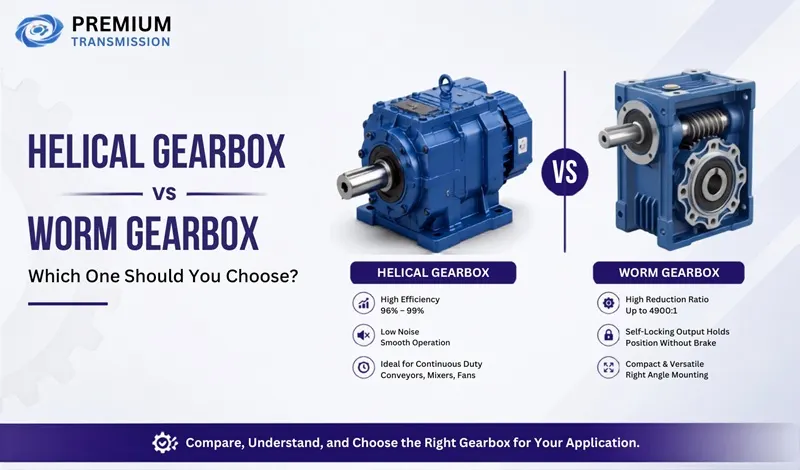
A helical gearbox uses gears with teeth cut at an angle to the shaft axis. The gears sit on parallel shafts and mesh through rolling contact. Multiple teeth are always in contact, spreading the load and reducing noise. Efficiency is high because rolling contact generates relatively little heat compared to sliding contact.
A worm gearbox uses a threaded worm shaft that meshes with a toothed worm wheel at 90 degrees. The contact is sliding rather than rolling. This is why worm gearboxes can achieve very high reduction ratios in a compact body, but at the cost of more heat generation and lower efficiency.
How Does a Helical Gearbox Perform in Practice?
Efficiency and Continuous Duty
Helical gearboxes operate at 96 to 99% efficiency per stage, making them one of the most energy-efficient gearbox configurations available. This matters significantly over the working life of a drive, particularly in applications running 16 to 24 hours a day. Rolling contact also means lower operating temperatures and longer bearing and seal life compared to sliding-contact designs.
Speed Range and Noise
Helical gears produce less vibration and noise than most other gear types because the angled teeth engage gradually rather than all at once. This makes them a preferred choice in food processing, pharmaceutical, and packaging plants where low noise is important. They handle high-speed motor inputs well and suit continuous duty cycles without additional cooling in most standard applications.
Reduction Ratios
Standard single-stage helical gearboxes typically cover reduction ratios from 1.22:1 to 5.06:1. Multi-stage configurations extend this range further. Modular designs from established helical gearbox manufacturers allow stages to be combined without custom engineering, giving buyers flexibility across a wide ratio range from a standard product catalogue. View the Standard Helical Gearbox range for full specifications.
How Does a Worm Gearbox Perform in Practice?
Efficiency and Heat Management
Worm gearboxes operate at 50 to 90% efficiency depending on the reduction ratio selected. Higher ratios produce more sliding contact, more heat, and lower efficiency. For continuous-duty applications, thermal management is important. Reputable worm gearbox manufacturers publish both mechanical power ratings and thermal power ratings in product catalogues, so buyers can check that the unit will operate within safe temperature limits at their required duty cycle. View the Standard Worm Gearbox range for duty cycle and thermal ratings.
Reduction Ratios and Self-Locking
Single-stage worm gearboxes achieve ratios from 5:1 up to 70:1. Double-stage units extend this to 4900:1. This high-ratio capability in a compact footprint is the primary reason worm gearboxes remain a standard choice for elevator drives, screw conveyors, and agitators. The self-locking feature, where the output shaft cannot back-drive the worm under load, is useful in lifting applications and can reduce or eliminate the need for a separate holding brake.
Size and Mounting
Worm gearboxes are generally more compact than helical units at equivalent reduction ratios. The 90-degree shaft arrangement also provides mounting flexibility in tight spaces where an inline or parallel-shaft configuration would not physically fit. For space-constrained plant layouts, this is often a decisive factor.
Helical vs Worm Gearbox: A Direct Comparison
| Feature | Helical Gearbox | Worm Gearbox |
| Shaft orientation | Parallel shafts | 90 degrees (right angle) |
| Efficiency per stage | 96 to 99% | 50 to 90% |
| Single-stage reduction | 1.22:1 to 5.06:1 | 5:1 to 70:1 |
| Max reduction (two-stage) | Up to ~657:1 | Up to 4900:1 |
| Noise level | Low | Low to moderate |
| Heat generation | Low | Moderate to high at high ratios |
| Self-locking output | No | Yes (most configurations) |
| Duty cycle suitability | Continuous, heavy-duty | Intermittent to continuous (thermal check required) |
| Typical applications | Conveyors, mixers, fans, agitators | Lifting drives, screw feeders, high-ratio compact drives |
Four Questions That Will Help You Choose
The right choice between helical and worm usually becomes clear once you answer these four questions about your application:
First, what efficiency does your drive need? If it runs continuously and energy cost is a real factor, a helical gearbox will deliver a lower operating cost over its working life.
Second, what reduction ratio do you need? If the ratio requirement is above 25:1 and a compact footprint matters, a worm gearbox is often the more practical single-stage option.
Third, does the output shaft need to hold position without a separate brake? If yes, a worm gearbox with confirmed self-locking characteristics is the appropriate choice.
Fourth, what is the duty cycle? For intermittent operation, a worm gearbox is practical across a wide range of efficiency levels. For continuous 24-hour operation, a helical unit carries less thermal risk and lower running cost.
How Different Industries Apply These Two Types
Conveyors in cement, steel, and material handling plants predominantly use helical gearboxes for efficiency and long service life under continuous load. Packaging and bottling lines specify helical units for quiet operation and precise speed control. Elevator drives, screw feeders, and gate mechanisms frequently use worm gearboxes for self-locking output and compact high-ratio drive. Sugar mills use both types, helical configurations on main drives and worm gearboxes on smaller auxiliary equipment. Premium Transmission manufactures both types at our manufacturing facility in Pune, supplying both standard and application-specific configurations to industries across India and international markets.
Frequently Asked Questions
Q1. Is a helical gearbox more efficient than a worm gearbox?
Yes, in most configurations. Helical gearboxes achieve 96 to 99% efficiency per stage through rolling gear contact. Worm gearboxes operate at 50 to 90% efficiency depending on ratio, due to the sliding contact between the worm and wheel. For continuous-duty drives, the efficiency difference has a direct impact on energy cost over the life of the equipment.
Q2. Can a worm gearbox be used for continuous duty?
Yes, but it requires careful selection. The thermal power rating of the unit must exceed the actual heat generated at the chosen ratio and duty cycle. Manufacturers publish both mechanical and thermal ratings for this reason. For high-ratio, continuous-duty applications, forced cooling or a larger frame may be needed to keep operating temperatures within limits.
Q3. Why do worm gearboxes generate more heat than helical gearboxes?
Worm gearboxes use sliding contact between the worm and the wheel rather than rolling contact. Sliding contact generates more friction, which converts some of the input power to heat instead of useful output torque. The proportion of power lost as heat increases at higher reduction ratios.
Q4. Which gearbox type is better for high reduction ratios?
For ratios above 25:1 in a compact footprint, a worm gearbox is typically the more practical and cost-effective choice. Single-stage units reach 70:1 and double-stage units reach 4900:1. Helical gearboxes can achieve high ratios through multiple stages, but this increases the physical size and cost compared to a worm unit at the same ratio.
Q5. What is the self-locking property of a worm gearbox and when does it matter?
Self-locking means the output shaft of the gearbox cannot be back-driven by the load when the motor is not running. In a worm gearbox, the geometry of the worm and wheel creates enough friction to hold the output stationary without a separate brake. This is important in lifting drives, gate mechanisms, and any application where the load must stay in position when the motor is stopped. Not all worm gearboxes are self-locking at all ratios, so this should be confirmed with the manufacturer for the specific unit selected.
About Premium Transmission
Premium Transmission is a gearbox manufacturing company headquartered in Pune, India, with four ISO 9001 certified manufacturing plants. The company manufactures helical gearboxes, worm gearboxes, planetary gearboxes, bevel helical geared motors, and fluid couplings for industries including cement, steel, sugar, mining, material handling, and food processing. For application support and product enquiries, visit the contact page, or explore the Bevel Helical Geared Motor range for high-efficiency right-angle drive solutions.