

Types of Gearboxes Explained: A Practical Guide for Industrial Buyers
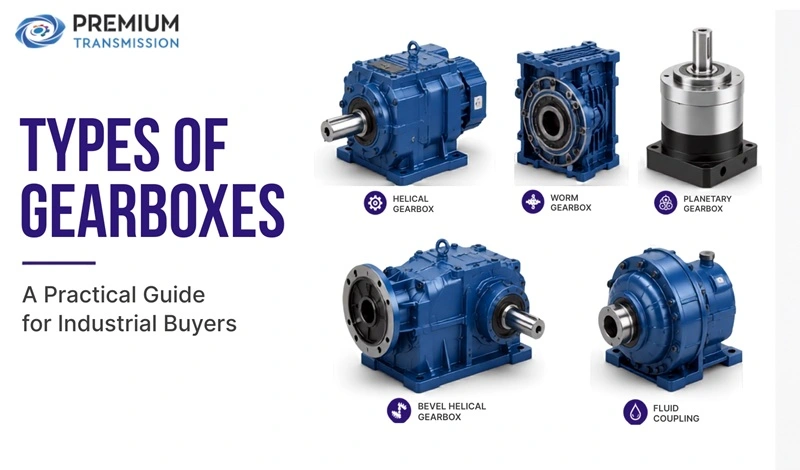
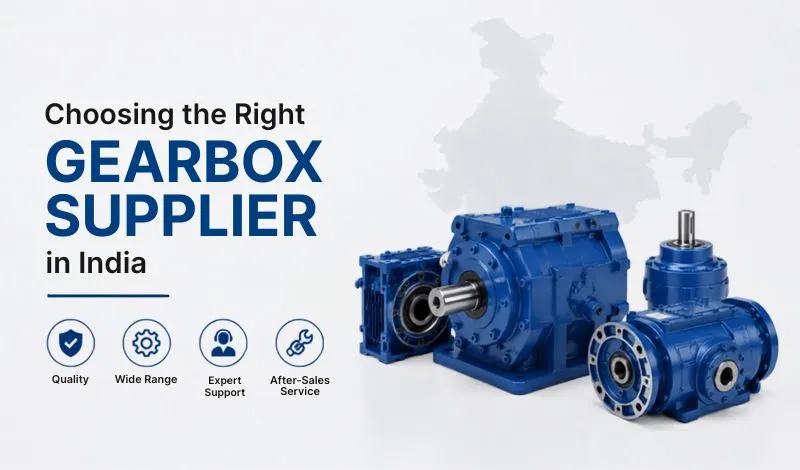
When you are evaluating gearbox manufacturers for a new plant or equipment upgrade, one of the first questions that comes up is which type of gearbox suits your application. Helical, worm, planetary, bevel helical, these terms appear throughout product catalogues and technical datasheets, but the differences are not always clear. This guide explains each major gearbox type in plain language, covering what each does well, where it is used, and what to consider when making a selection.
What Does a Gearbox Actually Do?
A gearbox is a mechanical assembly that transfers power from a motor to a driven machine, converting rotational speed and torque to match the requirements of the application. A motor running at 1450 RPM may need to drive a conveyor at 50 RPM. The gearbox handles that reduction while transmitting the torque needed for the load.
In industrial settings, the gearbox is often one of the highest-cost items in a drive train. Specifying the wrong type leads to higher energy consumption, faster wear, and unplanned downtime. Getting it right starts with understanding the available options and what each one is actually designed for.
What Are the Main Types of Industrial Gearboxes?
Helical Gearbox
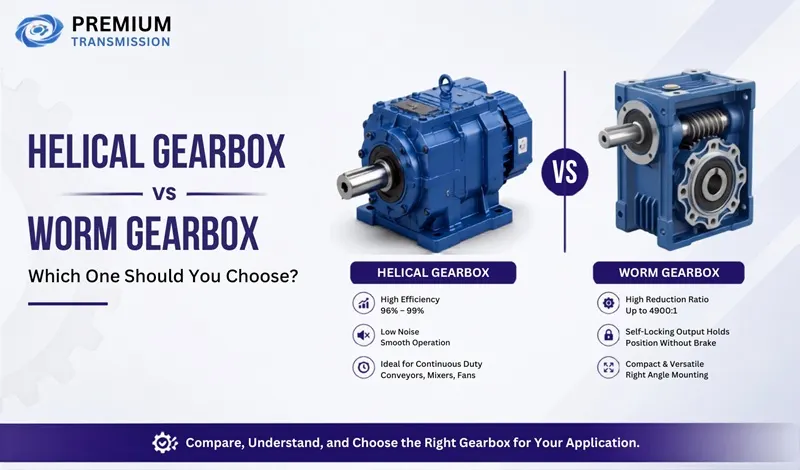
The helical gearbox is one of the most common configurations in industrial power transmission. Its teeth are cut at an angle to the gear axis, so multiple teeth engage at the same time. This produces smoother, quieter operation and a higher load capacity compared to straight-cut gears. Helical units typically achieve efficiencies of 96 to 99% per stage and are well suited to continuous-duty applications. You will find them on conveyor systems, mixers, fans, agitators, and a wide range of process equipment. Helical gearbox manufacturers offer both standard and modular variants, allowing different mounting orientations and shaft configurations on the same base unit. View the Standard Helical Gearbox range for full specifications.
Worm Gearbox
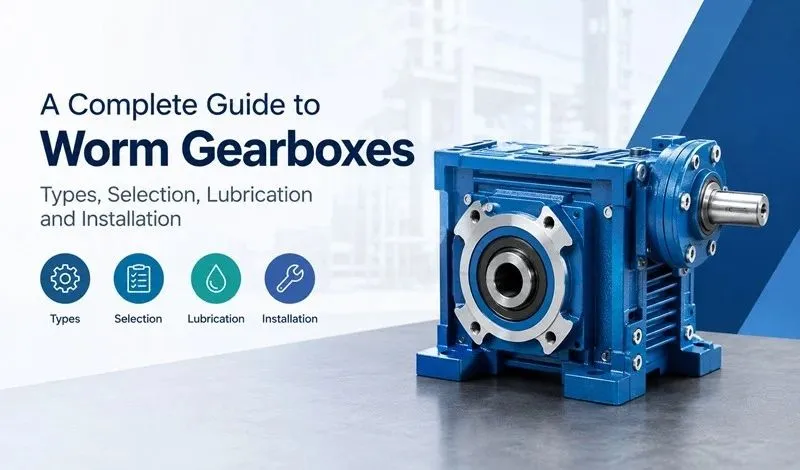
A worm gearbox transmits motion through a worm screw that meshes with a toothed worm wheel, with the two shafts oriented at 90 degrees. The main advantage is a high reduction ratio in a compact footprint. Single-stage worm units reach ratios of up to 70:1, and double-stage units can achieve 4900:1. Worm gearboxes are also self-locking in many configurations, meaning the output shaft cannot back-drive the worm under load. This makes them well suited for lifting equipment, screw feeders, and conveyors where the load must hold position. The trade-off is efficiency. Sliding contact between the worm and wheel generates more heat than helical gearing, so worm gearbox manufacturers publish duty cycle ratings to guide selection for continuous-duty applications. Explore the Standard Worm Gearbox range for power and ratio details.
Planetary Gearbox
A planetary gearbox uses a sun gear at the centre, a set of planet gears orbiting it, and an outer ring gear. Because the load is distributed across multiple planet gears simultaneously, this design achieves high torque capacity in a compact, coaxial package. Planetary units are specified for applications requiring high torque density and precise control, including centrifuges, printing equipment, conveyors, and industrial robots. They also deliver good torsional stiffness, which matters in positioning and motion control applications. The main trade-off is cost. Planetary units are more complex to manufacture than helical or worm types and are best chosen when space and torque density genuinely demand it rather than as a default.
Bevel Helical Gearbox
A bevel helical gearbox combines helical gearing with a bevel gear stage to transmit power at a right angle. Unlike a worm gearbox, the contact between bevel gears is rolling rather than sliding, which gives higher efficiency at the same 90-degree configuration, typically 95 to 98%. These units are commonly used in sugar mills, cooling towers, and heavy conveyor drives where high torque and right-angle output are both needed. For buyers who require more efficiency than a worm gearbox can deliver at an angular configuration, the bevel helical is the standard industrial choice. See the Bevel Helical Geared Motor range for application-specific configurations.
Fluid Couplings
Fluid couplings are not gearboxes in the traditional sense, but they are an important part of the power transmission family and are commonly paired with gearboxes. They transfer torque through hydraulic fluid rather than mechanical gear contact, providing a smooth, controlled start and protecting the motor and driven equipment from shock loads. Fluid couplings are a standard specification in belt conveyors, crushers, and any application where high peak starting currents or load shocks would otherwise reduce service life.
How Do These Gearbox Types Compare?
The table below gives a quick overview of efficiency, reduction range, and best use case for each gearbox type:
| Gearbox Type | Efficiency | Reduction Range | Noise Level | Best Used For |
| Helical | 96 to 99% | 1.22:1 to 657:1 | Low | Conveyors, mixers, fans, general process equipment |
| Worm | 50 to 90% | 5:1 to 4900:1 | Low to moderate | Lifting drives, high-ratio compact applications |
| Planetary | 97 to 99% | 16:1 to 1600:1 | Low | High torque, precision drives, compact space |
| Bevel Helical | 95 to 98% | 5.06:1 to 438:1 | Low | Right-angle drives, sugar mills, heavy industry |
Which Gearbox Type Is Right for Your Industry?
Cement and steel plants rely on heavy-duty helical and bevel helical gearboxes for kiln drives, mills, and conveyor systems where continuous high-torque loads are the norm. Sugar mills favour helical designs with the efficiency needed for long daily operating cycles. Material handling operations often specify modular helical gearboxes for their flexibility and low noise levels. Lifting and packaging equipment commonly uses worm gearboxes for self-locking capability and compact high-ratio drives. Planetary gearboxes appear in precision manufacturing, robotics, and wherever coaxial alignment and torque density are critical. Planetary Gearboxes are also used in very high torque applications like Sugar Mills, cement mills, coal pulverisers, etc. Oil, gas, mining, and outdoor applications require sealed, ruggedised units rated for wide temperature ranges and contaminated environments.
Frequently Asked Questions
Q1. What are the main types of gearboxes used in industry?
The main types are helical, worm, planetary, and bevel helical gearboxes, along with fluid couplings as part of the broader power transmission family. Each type serves different torque, speed, efficiency, and space requirements. Most industrial plants use more than one type across different drive applications.
Q2. What is the difference between a helical gearbox and a worm gearbox?
A helical gearbox transfers power between parallel shafts using rolling gear contact, offering high efficiency and smooth operation. A worm gearbox transmits power at 90 degrees through a worm and wheel arrangement, delivering higher reduction ratios in a compact footprint but at lower efficiency due to sliding contact between the worm and wheel.
Q3. Which gearbox type offers the highest reduction ratio?
Double-stage worm gearboxes can achieve reduction ratios up to 4900:1, making them the choice when very slow output speed is needed from a standard motor in a compact housing. Multi-stage planetary gearboxes can also reach high ratios but at greater unit cost and complexity.
Q4. Are planetary gearboxes better than helical gearboxes?
They are suited for different requirements. Planetary gearboxes offer higher torque density and coaxial (inline) alignment, making them better for compact, high-torque, or precision applications. Helical gearboxes are more cost-effective and better suited for general industrial drives with standard reduction requirements and continuous duty cycles.
Q5. How do I select the right gearbox for my application?
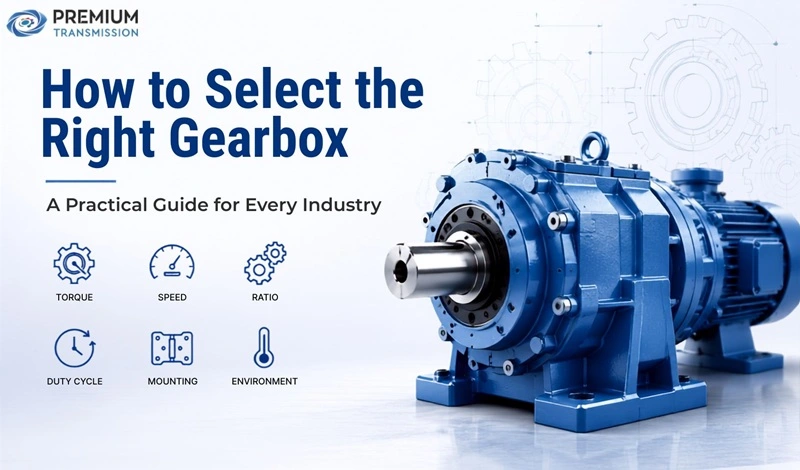
The key factors are output torque requirement, input speed, required reduction ratio, shaft orientation, duty cycle (continuous or intermittent), and environmental conditions such as dust, moisture, or temperature extremes. Working with experienced gearbox manufacturers who can review your full application data and site conditions gives you the most accurate and reliable selection.
About Premium Transmission
Premium Transmission is a gearbox manufacturing company headquartered in Pune, India, with four ISO 9001 certified manufacturing plants. The company supplies helical gearboxes, worm gearboxes, planetary gearboxes, bevel helical geared motors, and fluid couplings to industries including cement, steel, sugar, mining, and material handling across India and global markets. For product enquiries or application support, visit the contact page, or explore the Bevel Helical Geared Motor range for high-torque, right-angle industrial drive solutions.