

How to Select the Right Gearbox for Your Industry: A Practical Guide
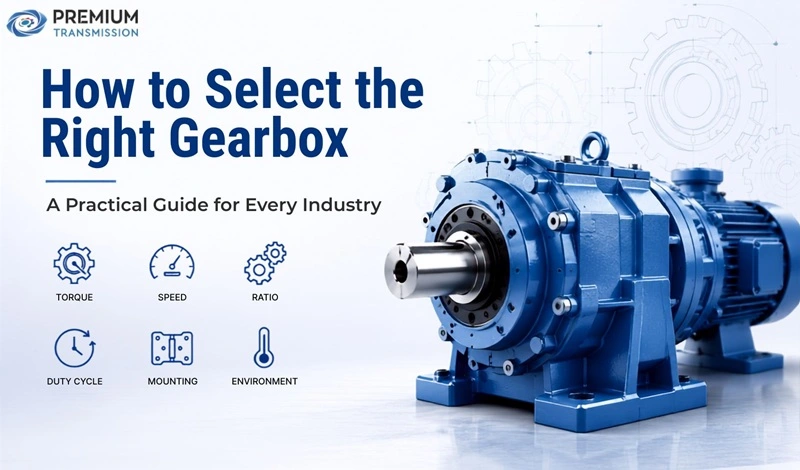
Choosing a gearbox from the right gearbox manufacturing company is not simply a matter of picking a catalogue item that fits the available space. The gearbox sits between your motor and your driven machine, and every parameter you specify, torque, speed, ratio, duty cycle, and environment, affects how reliably that drive will perform over its working life. Getting the selection right at the specification stage costs nothing. Getting it wrong costs significantly more in energy, maintenance, and downtime. This guide walks through each factor you need to consider and shows how to work systematically toward the right choice for your application.
Why Gearbox Selection Matters More Than Most Buyers Realise
A gearbox that is undersized for the actual load will fail before its expected service life. One that is oversized will work, but it costs more to purchase, weighs more, and consumes more energy than necessary. A unit specified for the wrong duty cycle will overheat in continuous operation even if the mechanical torque rating appears adequate. A gearbox with the wrong shaft arrangement or mounting orientation creates installation problems that delay commissioning and sometimes require costly on-site modifications.
The cost of correct selection is time and the right information. The cost of incorrect selection is equipment failure, unplanned downtime, and the expense of replacing a unit that was never right for the job.
Key Parameters You Need Before Selecting a Gearbox
These are the six pieces of information that any reputable gearbox manufacturer will ask for before making a recommendation:
| Selection Parameter | What You Need to Know | Where to Get the Data |
| Output Torque | Required torque at the driven shaft (Nm) | Machine datasheet or calculated from power and speed |
| Reduction Ratio | Input speed divided by required output speed | Motor nameplate and driven machine speed requirement |
| Duty Cycle | Hours per day, nature of load (steady or shock) | Process design or machine specification |
| Shaft Orientation | Parallel, right-angle, or coaxial | Plant layout and machine mounting arrangement |
| Service Factor | Multiplier applied to torque for load variations | Application category (conveyor, crusher, mixer, etc.) |
| Environment | IP rating, temperature range, dust, moisture | Site survey and environmental conditions report |
Output Torque Requirement
Torque is the primary sizing parameter for any gearbox. You need the output torque required by the driven machine, measured in Newton-metres (Nm). If you know the power of the driven equipment and the required output speed, you can calculate it: Torque (Nm) = (Power in kW x 9550) divided by Output speed in RPM. Apply a service factor on top of this calculated value to account for shock loads, starting conditions, and load variations. Most industrial applications use a service factor of 1.25 to 2.0 depending on load severity.
Input Speed and Required Output Speed
The input speed is typically the rated speed of the electric motor, commonly 960, 1440, or 2900 RPM for standard induction motors on an Indian 50 Hz supply. The required output speed is the speed at which the driven machine needs to operate. These two values give you the required reduction ratio directly.
Reduction Ratio
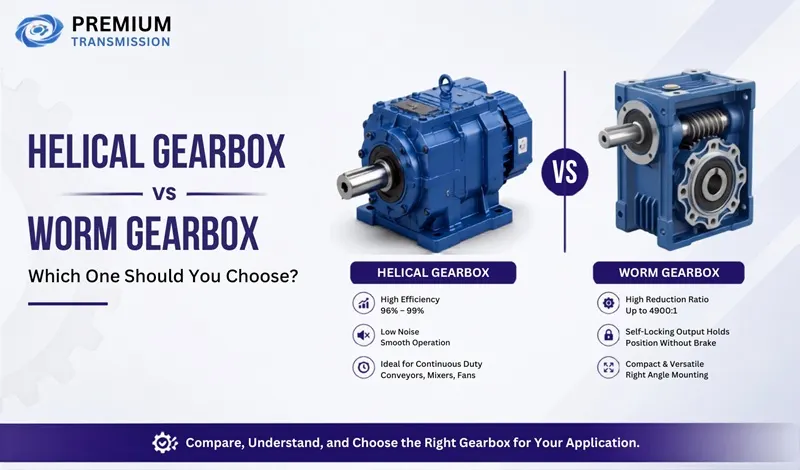
The reduction ratio is simply the input speed divided by the required output speed. A ratio of 20:1 means the output shaft turns once for every 20 turns of the input shaft. Different gearbox types cover different ratio ranges efficiently. Helical gearboxes cover 1.22:1 to 657:1 Worm gearboxes reach up to 70:1 in a single stage. Planetary gearboxes typically cover 16:1 to 1600:1. Choosing a type that covers your ratio natively avoids additional reduction stages and keeps the drive package compact.
Duty Cycle
Duty cycle defines how the gearbox is loaded over time. Continuous duty means full load without interruption, which is the most demanding thermal condition. Intermittent duty involves periods of operation followed by rest, allowing the unit to cool between cycles. Always specify actual operating hours per day and the nature of the load (steady, moderate shock, or heavy shock) when requesting a selection from any gearbox manufacturing company. For worm gearboxes particularly, the thermal power rating can be the limiting factor before the mechanical rating is reached.
Mounting Orientation and Shaft Configuration
Gearboxes are available in foot-mounted, flange-mounted, shaft-mounted, and combination arrangements. The shaft configuration refers to whether input and output shafts are parallel, at 90 degrees, or coaxial. Getting this right at the selection stage avoids the need for additional couplings, adapters, or brackets that add cost, weight, and alignment risk. The Standard Helical Gearbox and Standard Worm Gearbox ranges both offer multiple mounting configurations to suit different plant layouts.
Environmental Conditions
The operating environment affects the protection class, seal specification, and lubrication grade of the gearbox. Outdoor installations need higher IP ratings for dust and water ingress. High ambient temperatures affect lubricant viscosity selection. Corrosive environments in chemical, food processing, or coastal applications may require special coatings or stainless steel shaft options. Cold-start conditions below 5 degrees Celsius may need low-viscosity synthetic lubricants. Providing full site conditions to the supplier at the specification stage avoids selecting a unit that is mechanically correct but environmentally inadequate.
Matching Gearbox Type to Your Application
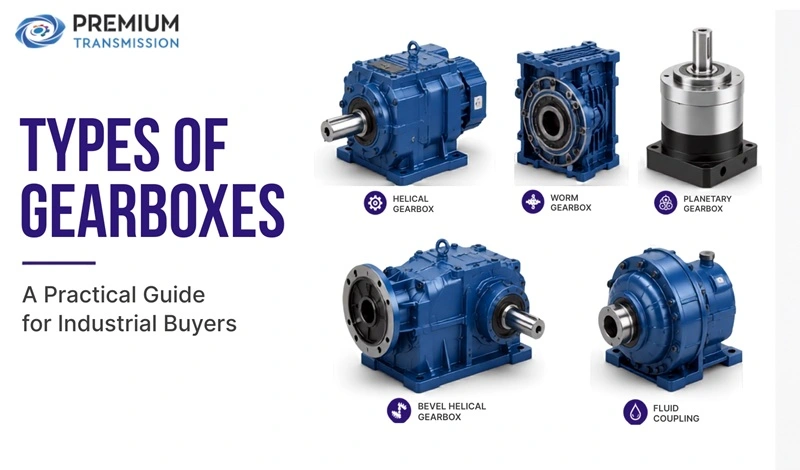
Once you have the key parameters, the gearbox type follows from the combination of ratio, shaft orientation, efficiency requirement, and space constraint. For general industrial drives with parallel shafts, ratios up to 657:1, and continuous duty, a helical gearbox is the standard choice. For right-angle output at high efficiency and high torque, the Bevel Helical Geared Motor is appropriate. For compact, high-ratio drives above 25:1 where the duty is intermittent or efficiency is secondary, a worm gearbox is the practical option. For high-torque, space-constrained, coaxial applications, a planetary gearbox is the correct specification. When the application does not fit clearly into one category, an experienced gearbox manufacturer will review the full parameter set and recommend the most suitable configuration.
What to Confirm With Any Gearbox Manufacturer Before You Order
Before placing an order, confirm these points with the supplier. Does the mechanical torque rating include an appropriate service factor for your application? Does the unit carry a published thermal power rating, and does it cover your duty cycle at the selected ratio? What lubrication is specified, and what are the recommended service intervals? What is the IP protection rating, and is it suitable for your site? What are the lead times for standard versus modified configurations? Is spare parts availability confirmed for the working life of the equipment?
These are standard questions for any industrial procurement and a reliable supplier will answer all of them clearly before you commit. To discuss your specific requirements with the Premium Transmission technical team, visit our contact page or find our manufacturing facility in Pune.
Common Gearbox Selection Mistakes to Avoid
Specifying on mechanical rating alone and ignoring the thermal rating is one of the most common mistakes in worm gearbox selection. The mechanical rating may appear adequate, but the unit overheats in continuous duty because the thermal power rating is lower than the applied load.
Applying no service factor means the gearbox operates at its nominal limit with no margin for load peaks, starting torque spikes, or vibration transmitted from the driven machine. A single heavy shock event can exceed the rated torque and cause gear or bearing damage.
Specifying the wrong shaft arrangement causes installation problems that are expensive to resolve after the equipment arrives on site. Confirm the exact input and output shaft positions, dimensions, and keyway details before the order is placed.
Selecting on purchase price alone without comparing efficiency leads to higher energy costs over the life of the drive, often exceeding the initial price difference many times over across a typical 10 to 15-year service life.
Frequently Asked Questions
Q1. What information do I need to select a gearbox?
The minimum information needed is output torque (or power and output speed), input speed, required reduction ratio, duty cycle (hours per day and load type), shaft orientation, and site environmental conditions. With these six parameters, any established gearbox manufacturing company can recommend the correct type, size, and configuration.
Q2. What is a service factor and why does it matter in gearbox selection?
A service factor is a multiplier applied to the calculated torque to account for real-world load variations, shock loads, and starting conditions that exceed the steady-state value. Using a service factor of 1.5, for example, means the gearbox is selected to handle 1.5 times the calculated torque. Without a service factor, the gearbox operates at its design limit and any load spike can cause premature failure.
Q3. How do I calculate the reduction ratio I need?
Divide the input speed (motor speed in RPM) by the required output speed (driven machine speed in RPM). For example, if your motor runs at 1440 RPM and your conveyor drive shaft needs to turn at 72 RPM, the required reduction ratio is 1440 divided by 72, which equals 20:1. This ratio then determines which gearbox types and sizes are suitable.
Q4. Can the same gearbox model be used across different applications?
A gearbox model covers a range of torque ratings and ratios within a product family, so the same basic design may suit multiple applications if the torque, ratio, and environmental requirements fall within its rated range. However, the specific configuration, mounting, shaft arrangement, lubrication, and IP rating may differ between applications and should be confirmed for each installation.
Q5. How do I know if a gearbox is suitable for outdoor or harsh environment installation?
Check the IP (Ingress Protection) rating of the unit. IP55 provides protection against dust and water jets and is a common minimum standard for outdoor industrial installations. IP65 offers full dust protection and water jet resistance. For submersible or washdown applications, higher ratings are needed. Also confirm the lubrication specification is appropriate for the ambient temperature range at your site, particularly for cold-start conditions.
About Premium Transmission
Premium Transmission is a gearbox manufacturing company headquartered in Pune, India, operating four ISO 9001 certified manufacturing plants. The company supplies helical gearboxes, worm gearboxes, planetary gearboxes, bevel helical geared motors, and fluid couplings to industries including cement, steel, sugar, mining, and material handling across India and international markets. Our technical team supports buyers through the full selection process, from application data review to product recommendation and commissioning support. Visit the contact page to start a conversation with our engineering team.